|
夏威夷吉他(Hawian Guitar)简介/人文历史/英文简介
夏威夷吉他:夏威夷吉他(Hawian Guitar),传统的夏威夷吉他外形类似于古典吉他,使用钢丝弦。演奏时平放在腿上,一手持金属滑棒按弦,另一只手带金属指套拨弦,音色华丽,是一种擅长表现旋律的乐器。
夏威夷吉他有着自己的共鸣方式外,还因为夏威夷吉他往往配有自己专用的弹奏器,一种是音棒:一般长80MM左右,为钢质圆棒,全棒光滑。另一种是用指甲:一般是用塑料物质制作成。其中食指和中指以铜片制成为佳。 夏威夷吉他分琴头、琴颈和琴箱三部分。琴头有执手,用于调节琴弦的张力而得到相应的音高。琴颈上为指板,指板上为音品,主要为左手弹奏区域。琴箱产生共鸣并将声音传导出去。演奏时,演奏者应该坐在适当高度的椅子上,两脚掌全着地,将吉他平稳地放在双膝上;右手前臂要有适当的压力,以便使乐器更稳定的放在膝上,避免吉他做任何不必要的移动。和古典吉他一样,正确的演奏姿势,在一定程度上有益于吉他的正确发音和演奏的舒适,并使演奏者处于最佳演奏角度。
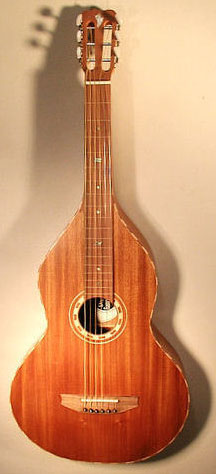
钢棒吉他(Steel Guitar)世纪初夏威夷的舶来品,钢棒吉他是滑棒吉他中的一种,但是它的琴板上没有"品"。在演奏时,演奏者总是一只手拨弦,另一只手在琴颈上套弄一根钢制的或玻璃棒。钢棒吉他一般拥有丰富的颤音。一种是短一些的放在怀里、膝盖上演奏的钢棒吉他(lap steel),还有一种有脚踏板的钢棒吉他(pedal steel guitar)。Darby and farlton在队中的Jimmy Tarlton是在乡村唱片中第一位加入钢棒吉他演奏的人,那是在1927年年初,后来随着技术的发展,原声乐器渐渐让位于电子乐器,但有一些保守主义者仍尽力抵制这一变化。在1953年,在Webb Pierce的唱片《Slowly》中,Bud Isaaca演奏的改进过的钢棒吉他受到了大众的欢迎。在后来的一两年之内,电子钢棒吉他在乡村乐队中越来越普遍。其中的佼佼者是Buddy Emmons和Shot Jackson。Pete Drake把这一乐器在60年代与Bob Dylan、Ringo Starr合作时,介绍给了更多的听众。今天,钢棒吉他以及它许多的衍生乐器已经在多姿多彩的乡村音乐中扮演了重要的角色。Paul Franklin是一个钢棒吉他的演奏高手,而在乡村老大剧院,Weldon Myrick在他的乐队中也演奏着这种乐器。
夏威夷吉他历史英文介绍Hawaiian Steel Guitar
Origins of the Hawaiian Steel Guitar 。As we know guitars while some guitars may have made their way to Hawaii in the early 1800's along with the many European sailors who visited Hawaii, the origin of Hawaiian guitar music is generally credited to the Mexican and Spanish cowboys who were hired by King Kamehameha III around 1832. It was from the Hawaiian cowboys, or paniolos, that the tradition of Hawaiian slack key guitar music finds its roots.
This Spanish guitar was a gut string guitar. The actual origins of the Hawaiian steel guitar may never be known for sure. As Brad Bechtel outlines on his Lap Steel Guitar page:
"Steel guitars were originally invented and popularized in Hawaii. Legend has it that in the mid 1890's Joseph Kekuku, a Hawaiian schoolboy, discovered the sound while walking along a railroad track strumming his Portuguese guitar. He picked up a bolt lying by the track and slid the metal along the strings of his guitar. Intrigued by the sound, he taught himself to play using the back of a knife blade." J.D. Bisignani in his Hawaii Handbook from Moon Publications adds to the story of Joseph Kekuku:
"Driven by the faint rhythm of an inner sound, he went to the machine shop at the Kamehameha School and turned out a steel bar for sliding over the strings. To complete the sound, he changed the cat-gut strings to steel and raised them so they wouldn't hit the frets. Voilà! Hawaiian Music as the world knows it today."
Brad Bechtel adds, "Other persons who have been credited with the invention of the steel guitar include Gabriel Davion, an Indian sailor, around 1885, and James Hoa, a Hawaiian of Portuguese ancestry." As explained by the Hawaiian Steel Guitar Association in their feature. "Some 'Steel' History..."[/link] "Until his death in Boston in 1932, Kekuku toured the United States and most of Europe teaching and popularizing the Hawaiian steel guitar."
"Although the popularity of steel guitar became firmly established in Hawai`i by the early 1900s, and soon after in the country music field, it had few teachers. Those early legendary steel players were so much in demand to perform and record that they had no time to teach others, had they wanted to. Thus, in the '60s the art and technique of playing Hawaiian steel was almost lost."
The art form itself has seen numerous offshoots and developments in its relatively short lifetime. As Randy Lewis explains in his The Steel Guitar - A Short History: "With the introduction of amplification in the 30's, the steel guitar (like the Spanish guitar) gained pickups and became the electric steel guitar. Since an acoustic body was no longer necessary and actually caused feedback problems, the steel guitar quickly acquired a solid body and became the first true lap steel."
"There is no one standard tuning for the steel guitar and the solid body electric steel allowed for instruments to be made with two, three and even four necks, each tuned differently. Multiple necks made holding the instrument on the lap almost impossible, and legs were added, making the first 'console' instruments, although a few single neck consoles were already being played by 'steelers' who preferred to stand. At the same time, the steel picked up two more strings (there were a few seven string steels) and by the end of WWII the double neck eight string console was fairly standard, although even today there are still many players who prefer a single neck six or eight, especially in Hawaiian and Western Swing music."
"In the early 50's several players began experimenting with adding pedals which raised the pitch of a string, and in 1953, Bud Isaacs was the first player to use a pedal steel guitar on a hit recording: "Slowly" by Webb Pierce. The sound quickly caught on and many steel players converted to playing the 'pedal sound'" Over the years the sound of the Hawaiian steel guitar has found its way into many forms of American and world music including blues, "hillbilly", country and western music, rock and pop and also the music of Africa and India.
夏威夷历史:“夏威夷”一词源于波利尼西亚语。公元4世纪左右,一批波利尼西亚人乘独木舟破浪而至,在此定居,为这片岛屿起名“夏威夷”,意为“原始之家”。最早发现该群岛的欧洲人是英国航海家詹姆斯?库克船长,他于1778年登上夏威夷群岛,次年被岛上居民杀害。1795年,卡米哈米哈酋长征服了其他部落,建立夏威夷王国。1898年,夏威夷被美国吞并,1959年成为美国第50个州。夏威夷地处中太平洋北部,由130多个岛屿组成,呈弧状横贯太平洋,长度达到1500英里。它紧靠北回归线,构成了波利尼西亚群岛的北方前锋。同时,它又处于美国的最南部,与墨西哥城、海南、加尔各答在同一纬度。面积:16650平方公里。首府:檀香山。语言:官方语言为英语和夏威夷语两种,但日常生活用语以英语为主。人口:19.3万。岛屿数量:132。主要岛屿:夏威夷大岛、茂宜岛、欧胡岛、可爱岛、尼豪岛、莫洛凯岛、拉纳岛、卡霍奥拉韦岛。气候:夏威夷全年的气温变化不大,变化很小,没有季节之分,2、3月最冷,8、9月最热,一年四季气温在14~32℃,通常情况下,从10月到次年4月雨量最大,随时可能下雨。旅游旺季是从12月中旬开始到复活节以及6月中旬到9月初。
夏威夷人文历史:夏威夷州名称来自波里尼西亚语, 意为"原始的家" Original home.一千多年前波里尼西亚人向本州各岛殖民. 一九○○年并入美国. 一九五九年八月二十一日成为美国第五十州. 以芙蓉花 Hibiscus 为州花. 本州别名叫做"爱洛哈之州" Aloha State(夏威夷人向人问候或离别之时, 常说:"爱洛哈". 其意义为爱).本州箴言:"守正义则存" The Life Of The Land Is Perpetuated In Righteousness.州府是檀香山 Honolulu, 为旅游胜地. 最引人的地方是外基基海滩 Waikiki Beach 全年风和日丽水蓝天青, 宜游泳, 冲浪, 可以荡舟, 也可以捕鱼. 每年进出檀香山的船舶, 约两千艘. 每天进出檀香山国际机场的旅客, 多至四○万人. 市内有夏威夷大学, 创于一九○七年, 学生两万多. 校内设立之东西研究中心 The East West Center, 甚著名.本州特征有三: 第一, 本州全是火山岛. 夏威夷群岛包括一三二个岛. 这是太平洋海底上一座高大的火山锥, 露出海面的部分. 太平洋底部发生大裂缝, 熔岩外流, 形成高大的火山, 其上有许多火山口, 形成许多山峰. 有些山峰露出海面, 即成为海岛. 第二, 本州属于热带气候. 这使美国有寒(阿拉斯加)、 温(美国大陆四十八州)、热(夏威夷群岛)三带的领土. 第三, 本州是美国的太平洋海空军基地, 及美、亚、澳三州航运中心, 地位十分重要.群岛气候属于回归型, 因为它位于北回归线附近, 受东北信风的影响, 迎风坡多雨, 北风坡少雨. 主要物产为蔗糖与凤梨(菠萝或黄梨). 后者产量约占全世界产量四分之三. 本州主要收入: 第一为国防工业. 第二是旅游业.第三是蔗糖业. 第四是菠萝业. 欧胡岛在夏威夷岛之西北方. 岛的南岸有珍珠港 Pearl Harbor 及檀香山(火奴鲁鲁 Honolulu). 前者是美国在太平洋内最大军港;后者是本州工商业中心. 此岛东距旧金山三,八○○公里;西距香港八,八九○公里.然而就是这么一个旖旎到让人眼皮发沉的地方,孕育了“勇敢者的游戏”——冲浪。夏威夷的冲浪运动至少已经有600年的历史了,1778年,库克船长踏上这片海岸时,当地人高超的冲浪技艺就让这群闯入者赞叹不已。夏威夷草裙舞.说起夏威夷,人们就会想起草裙舞。传说中第一个跳草裙舞的是舞神拉卡。她跳起草裙舞招待她的火神姐姐佩莱。佩莱非常喜欢这个舞蹈,就用火焰点亮了整个天空。自此,草裙舞就成为向神表达敬意的宗教舞蹈。现在,它已经变成用尤克里里琴伴奏的娱乐性舞蹈,观赏草裙舞成了游客游览夏威夷的保留节目。
厦门吉他网
|






