|
匹克吉他(Pick Guitar)
匹克吉他(Pick Guitar)也称爵士吉他,面板和背板都呈弧形,琴颈细长,使用钢丝弦,共鸣箱小而薄,面板两侧各有一个f形音孔,外形与提琴近似。琴的面板和背板略呈弧形,用匹克弹奏,音量较大。琴体较大,琴颈窄而长,指板有微小的弧度,便于横按。可独奏、伴奏、倍司、合奏,适合演奏爵士乐 。
“匹克”是英文Pick的译音,意即弹片——音拨、拨片。在我国,“匹克吉他”一语有两重意地一是捐演奏法,二是指用弹片演奏的一种吉他。现在,我想谈谈后者。
吉他可用手指、弹片、指甲(金属或塑料软米弹奏,但产生的效果不同。从而导出了不少演奏法,例如古典、弗拉门科、民谣、夏威夷、爵士等,用匹克演奏的方法常见于爵士乐、摇滚乐、拉丁美洲音乐、美国乡村音乐和民谣。我们常称用弹片演奏的方法叫“匹克吉他”演奏法,在我国吉他爱好者中很流行。
据说真正的匹克吉他源于爵士吉他,所以匹克吉他常指爵士吉他。
按理说,任何吉他都可以用弹片来演奏,但真正理想的吉他是爵士吉他,其次是性能比较接近的其他民歌式吉他。匹克吉他有它特殊的要求:例如,用弹片拨弦,无论速度多快,不可能同一时间内拨动二根U上的弦,总有一根弦先拨动,然后才到达第二根弦。为了提高演奏速度,匹克吉他的各弦间距要比古典吉他的小得多。古典音他的弦距约11毫米而匹克吉他则为9毫米左右。由于匹克吉他演奏颤音、滑音、装饰音较多。因此,手感要求较高些,又因常担任主旋律独奏、音准要求高。音色的统一性、均匀性和纯净度也很重要。
如果你想拥有一把理想的匹克吉他,在选择时应首先选用上孔式拱板形吉他。质量上乘的f孔吉他多数用手工精制,制作方法与高级提琴相似。世界上有名的吉他出自名家之手,例如美国的吉伯逊(GIBSON)一牌,莱斯保尔(LESPAUQ型和电声式霍华德、罗伯特(HOWARD J7tOBFjRT约,都是有名的拱板式电扩音吉他,国产品中相似的只有美声牌别IO型电扩音吉他。这种吉他的特点如下:
1.面板与背板是棋形,取材很讲究。面板用纹理细密的东北松,背板用俄木或核桃木,制作方法酷似提琴,共鸣箱边线嵌有花纹或拼线包边。
2.指板、弦码、弦枕呈弧形,以配合面板的形状,使弦的高度均匀。
3.琴体上部有单四肩或双凹房地有不四肩糊,这是便于左手向高把位移动。在弦码两侧有1形音孔,右侧装有护面塑料板。
4.为了调整手感和音准,一般将弦码制成河丁阿P降或前后移动的型式,可精密调节弦的高度和个别弦的音准误差。
5.琴颈内有抗扭曲钢条,可调整琴颈的前、后倾斜度和弯曲度。
6.指板比古典式吉他窄,并直弧形。共M十格音品。采用密封式立轴型弦轴,在指权与琴头上采用彩色螺甸嵌饰,花纹典雅。7.匹克吉他发音明亮,音域均匀,低音弦的持续音不很长,弦的张力大,故采用金属弦,国产品中以美声牌高级吉他弦较适用。匹克吉他作为一个品种的界限不如夏威夷吉他那么明确,有关这方面的资料很少,有很多地区是用民欣(民谣)吉他作匹克吉他使用的。笔者仅以一管之见提供大家参考。
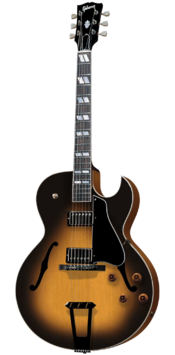
This article is about the types of guitars and guitar playing styles used in jazz. For performers who play jazz guitar, see jazz guitarist.The term jazz guitar may refer to either a type of guitar or to the variety of playing styles used in the various genres which are commonly termed "jazz." The guitar has a long history in jazz music, as both an ensemble and solo instrument. These styles were shaped by some of the genre's influential jazz guitarists.While jazz can be played on any type of guitar, from an acoustic instrument to a solid-bodied electric guitar such as a Fender Stratocaster, the archtop guitar has become known as the prototypical "jazz guitar." Archtop guitars are steel-string acoustic guitars with a big soundbox, arched top, violin-style "F" holes, a "floating bridge" and magnetic or piezoelectric pickups. The earliest guitars used in jazz were acoustic. While acoustic guitars are still sometimes used in jazz, most jazz guitarists since the 1940s have performed on an amplified electric guitar, typically an archtop with a magnetic pickup.
Jazz guitar playing styles include "comping" with jazz chord voicings (and in some cases , walking basslines) and "blowing" (improvising) over jazz chord progressions with jazz-style phrasing and ornaments. When jazz guitarists play chords underneath a song's melody or another musician's solo improvisations, it is called "comping", a portmanteau of "accompanying" and complementing. When jazz guitar players improvise, they use the scales, modes, and arpeggios associated with the chords in a tune's chord progression.
History
1900-mid-1930s
The stringed, chord-playing rhythm instrument typical of jazz ensembles from 1900 until the early 1920s was the banjo, an instrument which was much louder than guitars of the time. The banjo could generate enough sound to be heard in groups which included military band-style instruments such as brass, saxes, clarinets, and drums, such as early jazz groups. As the acoustic guitar became a more popular instrument in the early 20th century, guitar-makers began building louder guitars which would be useful in a wider range of settings.
The Gibson L5, an acoustic archtop guitar which was first produced in 1923, was an early “jazz”-style guitar which was used by early jazz guitarists such as Eddie Lang. By the 1930s, the guitar began to displace the banjo as the primary chordal rhythm instrument in jazz music, because the guitar could be used to voice chords of greater harmonic complexity, and it had a somewhat more muted tone that blended well with the upright bass, which, by this time, had almost completely replaced the tuba as the dominant bass instrument in jazz music.
The next important development in jazz guitar came in the mid to late-1930s with the advent of electrical amplification. Although Gibson was not the first commercial producer to make an electric guitar, the company made the first successfully-marketed electric guitar, the ES150 in 1936. It was an acoustic archtop fitted with a guitar pickup, which sensed the vibrations in the metal strings so that they could be amplified by a guitar amplifier. When guitarist Charlie Christian used the amplified electric guitar to improvise horn-like, single-line melodies in the jazz context, jazz and blues musicians became interested in the potential of the louder, new electric guitar. His playing was heard by millions in the recordings he cut with Benny Goodman.
Late 1930s-1960s
During the late 1930s and through the 1940s -the heyday of big band jazz and swing music -the electric guitar was an important rhythm section instrument. Some guitarists, such as Freddie Green of Count Basie’s band, developed a guitar-specific style of accompaniment. Few of the big bands, however, featured amplified guitar solos, which were done instead in the small combo context. The most important jazz guitar soloists of this period included the French Gypsy virtuoso Django Reinhardt, best known for his recordings with Stephane Grappelli, and Oscar Moore who was featured with Nat “King” Cole’s trio.
Duke Ellington's big band had a rhythm section that included a jazz guitarist, a double bass player, and a drummer (not visible).It was not until the large-scale emergence of small combo jazz in the post-WWII period that the guitar took as a versatile instrument, which was used both in the rhythm section and as a featured melodic instrument and solo improviser. In the hands of Kenny Burrell, Herb Ellis, Barney Kessel, Jimmy Raney, and Tal Farlow, who had absorbed the language of bebop, the guitar began to be seen as a “serious” jazz instrument. Improved electric guitars such as Gibson’s ES175 (released in 1949), gave players a larger variety of tonal options. In the 1940s through the 1960s, players such as Wes Montgomery, Joe Pass, and Jim Hall laid the foundation of what is now known as "jazz guitar" playing.
1970s
As jazz-rock fusion emerged in the early 1970s, many players switched to the more rock-oriented solid body guitars. Other jazz guitarists, like Grant Green and Wes Montgomery, turned to applying their skills to pop-oriented styles that fused jazz with soul and R&B, such as soul jazz-styled organ trios. Younger jazz musicians rode the surge of electric popular genres such as blues, rock, and funk to reach new audiences. Guitarists in the fusion realm fused the post-bop harmonic and melodic language of musicians such as John Coltrane, McCoy Tyner, Ornette Coleman, and Miles Davis with a hard-edged (and usually very loud) rock tone created by iconic guitarists such as Cream's Eric Clapton who'd redefined the sound of the guitar for those unfamiliar with the black blues players of Chicago and, before that, the Delta region of the Mississippi upon whom his style was based. With John Mayall's Blusbreakers, Clapton turned up the volume on a sound already pioneered by Buddy Guy, Freddie King, B.B. King and others that was fluid, with heavy finger vibratos, string bending, and speed through powerful Marshall amplifiers.
Fusion players such as John McLaughlin adopted the fluid, powerful sound of rock guitarists such as Clapton and Jimi Hendrix. McLaughlin was a master innovator, incorporating hard jazz with the new sounds of Clapton, Hendrix, Beck and others. McLaughlin later formed the Mahavisnhu Orchestra, an historically important fusion band that played to sold out venues in the early 70s and as a result, produced an endless progeny of fusion guitarist. Guitarists such as Al Di Meola, Larry Coryell, John Abercrombie, John Scofield and Mike Stern (the latter two both allumni of the Miles Davis band) fashioned a new language for the guitar which introduced jazz to a new generation of fans. Like the rock-blues icons that preceded them, fusion guitarists usually played their solid body instruments through stadium rock-style amplification, and signal processing “effects” such as simulated distortion, wah-wah, octave splitters, compression, and flange pedals. In addition, they also simply turned up to full volume in order to create natural overdrive such as the blues rock players.
1980s-2000s
By the early 1980s, the radical experiments of early 1970s-era fusion gave way to a more radio-friendly sounds of smooth jazz. Guitarist Pat Metheny mixed the sounds of blues, country, and “world” music, along with rock and jazz, playing both a flat-top acoustic guitar and an electric guitar with a softer, more mellow tone which was sweetened with a shimmering effect known as as “chorusing". During the 1980s, a neo-traditional school of jazz sought to reconnect with the past. In keeping with such an aesthetic, young guitarists of this era sought a clean and round tone and they often played traditional hollow-body archtop guitars which were played without electronic effects.
As players such as Bobby Broom, Peter Bernstein, Howard Alden, Russell Malone, and Mark Whitfield revived the sounds of traditional jazz guitar, there was also a resurgence of archtop luthierie (guitar-making). By the early 1990s many small independent luthiers began making archtop guitars. In the 2000s, jazz guitar playing continues to change. Some guitarists incorporate a Latin jazz influence, acid jazz-style dance club music uses samples from Wes Montgomery, and guitarists such as Bill Frisell continue to defy categorization.
Types of guitars
While jazz can be played on any type of guitar, from an acoustic instrument to a solid-bodied electric guitar such as a Fender Stratocaster, the archtop guitar has become known as the prototypical "jazz guitar." Archtop guitars are steel-string acoustic guitars with a big soundbox, arched top, violin-style "F" holes, a "floating bridge" and magnetic or piezoelectric pickups. Early makers of jazz guitars included Gibson, Epiphone, D'Angelico and Stromberg.
A hollow-bodied Epiphone guitar with violin-style "F" holes.The earliest guitars used in jazz were acoustic. While acoustic guitars are still sometimes used in jazz, most jazz guitarists since the 1940s have performed on an amplified electric guitar, typically an archtop with a magnetic pickup. In the 1990s, there was a resurgence of interest among jazz guitarists in acoustic archtop guitars with floating pickups. Sitka spruce, European spruce, and Engelmann spruce are most often used for the resonant tops of archtop and flattop guitars, although some guitar builders use Adirondack Spruce (Red Spruce), or Western Red Cedar. Archtop guitars often have Curly Maple or Quilted Maple backs.
Mass-produced archtop guitars are made by several different manufacturers. There are also a smaller number of handmade archtop and flattop guitars made on a small scale. Builders of handmade guitars take about six months to make each jazz guitar. Builders have to spend time choosing the maples, spruces and exotic woods, building the instrument, adding decorative inlays and purfling, and applying a hand-rubbed lacquer finish. [1] The most expensive archtop guitars may have a range of high-end features, such as "boutique" pickups with hand-wound magnets, wooden volume and tone knobs, and built-in condenser microphones, piezoelectric pickups, and preamplifiers.
Playing styles
Jazz guitar playing styles include "comping" (accompanying) with jazz chord voicings (and in some cases , walking basslines) and "blowing" (improvising) over jazz chord progressions with jazz-style phrasing and ornaments.
厦门吉他网
厦门吉他培训中心
|






