|
吉他制作大师安东尼奥·托列斯Antonio de Torres简介
东尼奥·托列斯1817年6月18日出生于西班牙San Sebastián de Almería;1892年11月19日逝世于西班牙San Sebastián de Almería。托列斯的全名是Don Antonio de Torres Jurado安东尼奥·卡尼萨·德·托列斯,可以说是由于他的丰功伟绩,才有了我们今天的古典吉他。
当Torres还在为格拉纳达的吉他制作家José Pernas工作的时候,就接触到了一位在当时具有相当超前意识的吉他演奏家Julián Arcas。那时的Arcas对自己手中的吉他的音色和音量都不很满意,于是他将自己的想法告诉了Torres,以求得能够对吉他进行一些改进,弥补这些不足。
靠着Torres天才的创造力和高超的制作工艺,古典吉他的外观和结构都有了很大的变化,较之19世纪的吉他,在共鸣箱上大了不少,趋向于我们现在所见到的古典吉他。在Acars之后,Torres又与塔雷加合作,继续对吉他进行改进,终于确立了现代古典吉他的外型。
Torres在制琴方面可以分为两个阶段。第一个阶段是从1850年到1869年。此后,他退休不再制作吉他,而改行销售瓷器。到了1880年,Torres又重新开始进行吉他的制作,直到他去世为止。在这期间,他制作出了许多非常优秀的吉他。Torres从来不在自己制作的吉他的标签上签名,但是在其制琴的第二阶段,他会在标签上写上编号。
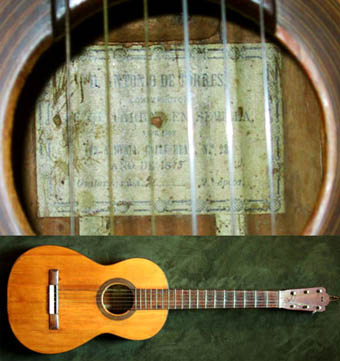
附:1869年,泰雷加结识了西班牙天才吉他制作家安东尼奥·卡尼萨·德·托列斯。托列斯是十九世纪的吉他制作家,他革新了吉他制作工艺,被称为吉他制作史上的斯特拉蒂瓦里(世界上著名的意大利小提琴制作之王,也是近代小提琴原形的奠基人)。托列斯在听完泰雷加用普通吉他的演奏之后,拿出一把他自己制作的吉他给泰雷加,对他说:"这才是你应当用的吉他。"从此,这把琴伴随泰雷加约20年之久。

Antonio de Torres Jurado (June 13, 1817 – November 19, 1892) was a Spanish guitarist and guitar maker.Torres is as revered among guitarists as Antonio Stradivari is revered among violinists. His work established the shape, design, and construction of the modern classical guitar.Born in La Cañada de San Urbano, Almería, Antonio de Torres was the son of Juan Torres, a local tax collector, and Maria Jurado. As was common, when he was 12 he started an apprenticeship as carpenter. In 1833, a dynastic war broke out, and soon after Torres was conscripted into the army. Through his father's machinations, young Antonio was dismissed as medically unfit for service. As only single men and widowers without children were draftable, his family pushed Torres into a hastily arranged marriage to the 13 year old daughter of a shopkeeper. And, in 1835 Antonio wed Juana María López. Children soon followed: a daughter in 1836; and another in 1839, a third in 1842 who died a few months later. His second daughter also died. And, in 1845 his wife died at the age of 23 of tuberculosis. These were difficult years for Torres, he was often in debt, and looking for more lucrative forms of employment.
Although there is some debate as to who taught Torres, one theory is that some time around 1842, Torres may have gone to work for José Pernas in Granada, rapidly learning to build guitars. He soon returned to Sevilla, and opened a shop on the calle Cerrageria No. 7 that he shared with Manuel Soto y Solares. Although he made some guitars during the 1840s, it was not until the 1850s on the advice of the renowned guitarist and composer Julián Arcas, that Torres made it his profession, and he began building in earnest. Julian Arcas offered Torres advice on building, and their collaboration turned Torres into an inveterate investigator of the guitar construction. Torres reasoned that the soundboard was key. To increase its volume, he made his guitars not only larger, but fitted them with thinner, hence lighter soundboards that were arched in both directions, made possible by a system of fan-bracing for strength. To prove that it was the top, and not the back and sides of the guitar that gave the instrument its sound, in 1862 he built a guitar with back and sides of papier-mâché. (This guitar resides in the Museu de la Musica in Barcelona, unfortunately it is no longer playable). Another of his experiments --perhaps a better description would be a display of his craftsmanship-- was a guitar made like a Chinese puzzle that could be assembled without glue, and disassembled would fit in a shoe box. Torres was a secretive man, and so had no disciples, but in a letter to his friend Juan Martinez Sirvent explained: "my secret is one you have witnessed many times, and one that I can't leave to posterity, because it must with my body go to the grave, for it consists of the tactile senses in my finger pads, in my thumb and index finger that tell the intelligent builder if the top is or is not well made, and how it should be treated to obtain the best tone from the instrument."
In 1868, Torres married again, wedding Josefa Martín Rosada. Shortly after, Torres met Francisco Tarrega for the first time. Tarrega then a kid of seventeen had come to Sevilla from Barcelona to buy a Torres from the maker of Julían Arcas' instrument. Torres offered him a modest guitar he had in stock, but on hearing him play, offered him a guitar he had made for himself a few years before. About 1870, Don Antonio then in his 50's closed his shop in Sevilla, and moved back to Almería where he and his wife opened up a china and crystal shop on the calle Real. About five years latter, Don Antonio began his "second epoch" as he refers to it on the labels of his guitars, building part-time when not busy in the china shop. After the death of his wife, Josefa, in 1883, Torres began to devote increasing amounts of time to building making some 12 guitars a year until his death in La Cañada de San Urbano, Almería at the age of 75.Torres guitars are divided into two epochs. The first, belonging to Sevilla from 1852-1870; the second, being the years 1871-1893 in Almería. The guitars Torres made were so superior to those of his contemporaries that their example changed the way guitars were built, first in Spain, and then in the rest of the world. Although they are not particularly loud by modern standards, they have a clear, balanced, firm and rounded tone, that projects very well. His guitars were not only widely imitated and copied, but as he never signed his guitars, and only numbered those from his second epoch, over the years many fakes Torres have been made, some made by well-known and expert makers.
This is an incompleted list of the guitars Antonio de Torres made.
FE 09 (1859) - owned by Miguel Llobet, now in the collection of the Museu de
la Música, Barcelona, Spain
SE 49 (1883) - owned by Francisco Tarrega
Serial number unknown (1856) - The Romeros have 5 Torres guitars, currently
probably the largest private collection in the world. Pepe Romero ownes 3
Torres (including a 1856 Torres); Celin Romero and Angel Romero each own one.
SE 107 (1887) - now is being played by Stefano Grondona.
FE 04 'La Leona' (1856) - now is being played by Wulfin Lieske. video
FE 17 (1864) - initially made by Torres for his personal use, acquired by
Francisco Tarrega in Seville, in 1869 [1]. The back and ribs was made from
flamed maple. Sold by Vicente Tarrega (brother of Francisco Tarrega) to
Domingo Prat in 1917.
SE 114 (1888) - owned by Francisco Tarrega, now in the collection of Sheldon
Urlik
SE 116 'La Italica' (1888) - once owned by Barcelona luthier Enrique Coll
(disciple of Simplicio and mentor of Fleta.)
厦门吉他网
|






