|
吉他历史与发展纲要/英文版(Some Guitar History)
Here follows a brief Timeline 吉他发展纲要
1265 Juan Gil of Zamora mentions the early guitar in "Ars Musica".
1283-1350 Guitarra Latina & Guitar Moresca are mentioned multiple times in the poems of the Archpriest of Hita
1306 A "gitarer" was played at the Feast of Westminster in England
1404 "Der mynnen regein" by Eberhard Von Cersne makes reference to a "quinterne."
1487 Johannes Tinctoris described the guitarra as being invented by the Catalans. This refers to the four course guitar. Each course represents one pair of double strings.
1546 "Tres Libros de Musica en Cifras para Vihuela" by Alonso Mudarra is the first publication to include music for guitar.
1551-1555 Nine books of tablature were published by Adrian Le Roy. These include the first pieces for 5 course guitar. The addition of the fifth course was attributed to Vicente Espinel
1600-1650 Many publications of tablature for the guitar. It's popularity begins to rival the lute.
1674 Publication of "Guitarre Royal" by F. Corbetta increased the guitar's popularity. It was dedicated to Louis XIV.
1770-1800 A sixth string was added to the guitar and the courses were replaced by single strings.
1800-1850 Guitar enjoyed a large popularity both in performances and publishing. Fernando Sor, Mauro Guiliani, Matteo Carcassi and Dioniso Aguado all performed, taught, wrote and had published their compositions.
1850-1892 Guitar maker Antonio de Torres develops the larger more resonant instrument we know today.
1916 Segovia performs at Ateneo, the most important concert hall in Madrid. Before this it was thought that the guitar did not have the volume for this type of venue.
1946 Nylon replaces gut as a string material Back To Lute & Guitar.
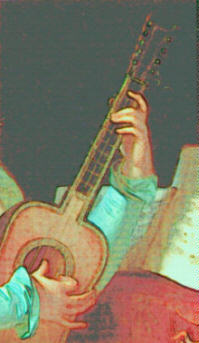
The guitar's roots are in Spain. Realistically, it cannot be traced back further than the 15th Century. It is thought to have been invented by the people of Malaga. This early instrument was a "four course" guitar, from which the ukulele is derived. The first guitars were very small, and were originally strung with four pair of strings. Each pair was call a course.
During the Renaissance, the guitar never had the respect the lute enjoyed. It was not considered a serious instrument. The first publication for guitar is thought to have been Alonso Mudarra's "Tres Libros de Musica en Cifras para Vihuela." Eventually, the guitar began to attract players, more publications and music began to appear.
During the During the Baroque period, A fifth course was added. Even more music became available. It's repertoire and the complexity of the music increased.
The fifth course was tuned in one of three ways.
A low "A" as it is now.
A low "A" plus an octave for the second part of the course
Both strings an "A" an octave higher than the modern guitar.
If a modern player really wants to have a complete, accurate repertoire of the Baroque Guitar, it would be necessary to either re-string for different pieces, or have at least three instruments for the different tunings.
At the end of the Baroque period two significant changes were made. The double strings were replaced by single strings, and instead of five pari, there were six single strings.
During the Classical period there were many publications, composers and performers. Fernando Sor, Mauro Guilliani, Matteo Carcassi, Fernando Carulli and many others wrote music, published methods and performed concerts. The guitar was very popular and guitar concerts were common.Sor played the guitar as a solo instrument at the London Philharmonic Concert in 1817. In memoirs, George Hogarth stated: "He astonished the audience by his unrivaled execution." Paganinni was also active, playing and writing for the guitar as well as the violin. Stradivarius made guitars as well as violins.
At the end of the 19th century, the guitar had fallen out of favor, but was resurrected by Francisco Tarrega. His best piece in my opinion is the now very famous "Receurdos De La Alhambra." He did few public performances and chose to perform for friends at his home. He did compose, and he wrote a method for teaching guitar. He also transcribed many pieces of music for the guitar.
Segovia was one of many guitarists that were influenced by him. Tarrega began the tradition of playing with the fingernails.Up until this point the instrument itself was small and narrow. Antonio de Torres (1817 - 1892) worked with the design and construction of the guitar. He increased the size and experimented with anything that would improve the sound, and was especially interested in volume. He was the first maker to use "fan" bracing underneath the top. He once built a Guitar with a spruce top and paper mache back and sides to prove his theory that it was the top that produced most of the volume. He was the father of the modern guitar.
Some well known composers who played the guitar are Carl Maria Von Weber, Rossini and his wife, Verdi, and for many years Franz Schubert did his composing on his guitar which hung over his bed. He didn't have a piano at the time. Berlioz also composed the guitar.
Segovia performed, transcribed, taught and discovered a tremendous amount of music. He also encouraged many composers to write for the guitar. He was the first person to perform in a concert hall... Before Segovia, people believed this could not be done.
Although Segovia did all these things, the real debt that we owe to him is that of making the guitar truly a world instrument. By traveling and performing throughout the world, he brought respect and recognition to the instrument.Nylon strings were a big improvement over gut strings. They replaced gut in 1946.
Today there are many concerts of guitar music. There are many societies and magazines devoted to the guitar.
厦门吉他网
|






